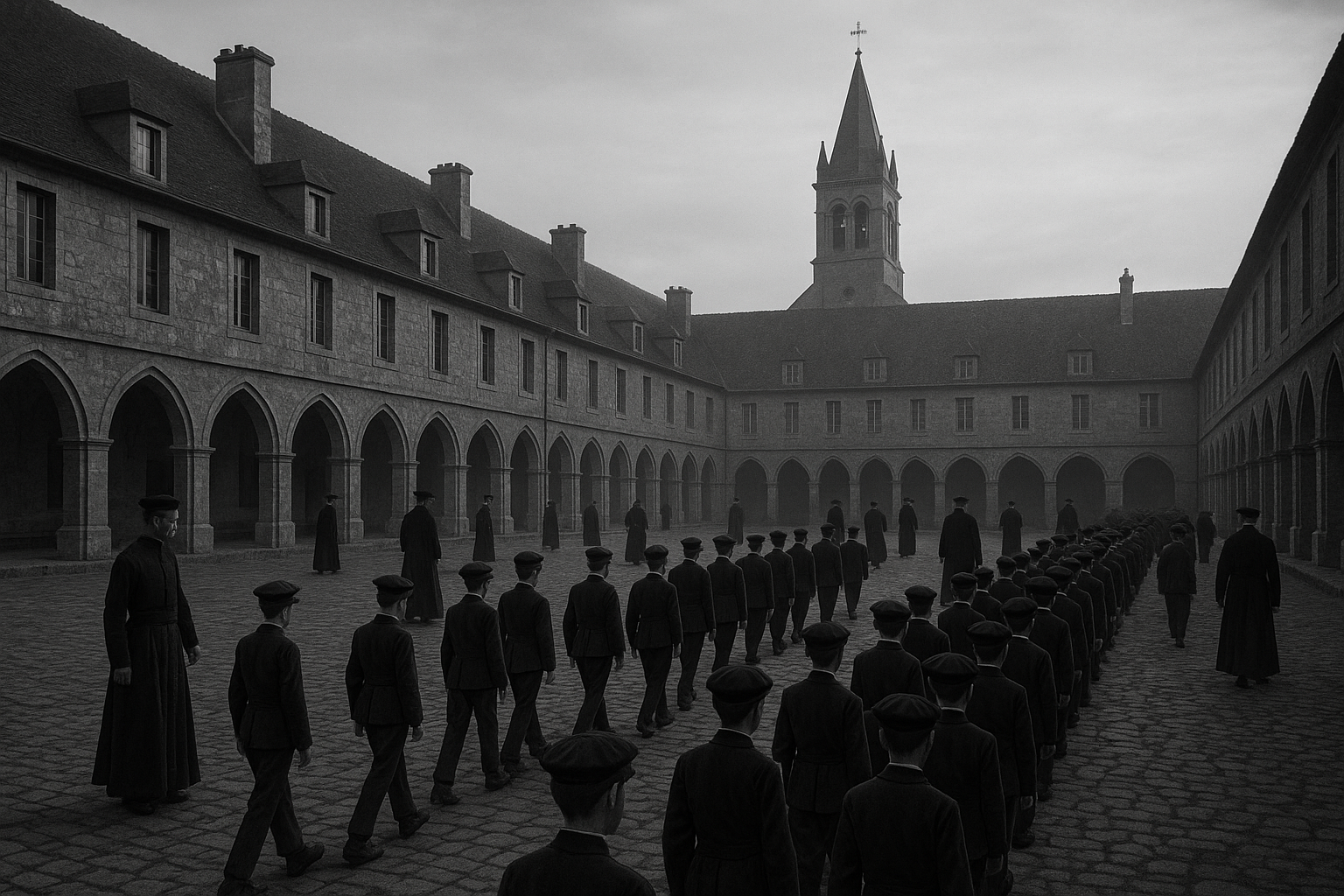
When Roger Peyrefitte published Les Amitiés particulières in 1944, he wasn’t just telling a story about forbidden love in a Catholic boarding school. He was capturing two distinct historical moments: the rigid world of 1920s French Catholic education where his story unfolds, and the tumultuous final year of World War II when his book emerged into a world desperate for authentic voices and honest literature.
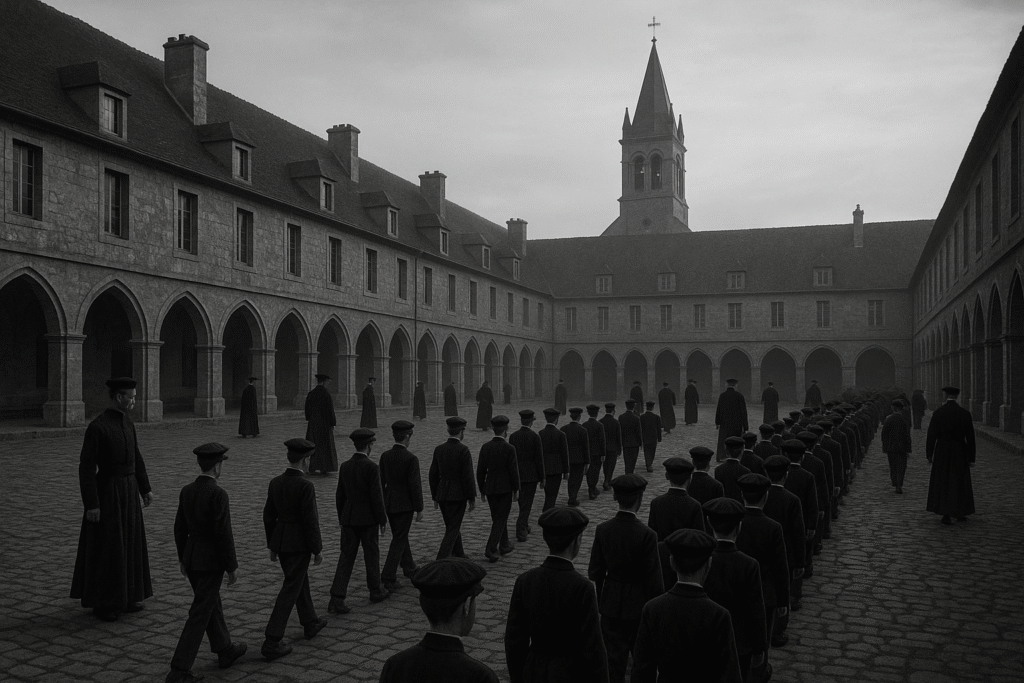
Part One: The 1920s Setting – A World Apart
Catholic Boarding Schools in Post-War France
The Catholic boarding school where Peyrefitte sets his story represents a very specific slice of French society in the 1920s. These institutions weren’t just schools, they were total environments designed to shape young men according to Catholic doctrine and French social expectations.
In the aftermath of World War I, France was rebuilding not just its cities and economy, but its sense of moral order. Catholic education played a crucial role in this reconstruction, drawing on a centuries-old tradition that had evolved by the 1920s but maintained its fundamental character: total institutional control over students’ lives. These boarding schools operated as self-contained worlds, often located in remote areas. Students lived completely cut off from the outside world, seeing their families only during holidays. The isolation wasn’t accidental, it was designed to maximize the school’s influence over the boys’ moral and intellectual development.
The Social Architecture of Control
The daily life in these institutions followed rigid patterns. Students woke to bells, attended mandatory religious services, studied classical subjects like Greek and Latin, and lived under constant supervision.
What made these environments particularly intense was their homosocial nature. Boys spent years together with minimal contact with the outside world, creating relationships that could be incredibly deep and emotionally charged. The priests who ran these schools were acutely aware of the potential for what they termed “particular friendships” – relationships that went beyond ordinary friendship into territory they considered dangerous.
The term “amitiés particulières” itself comes from Catholic educational discourse. It was code for relationships between students that showed signs of emotional or physical intimacy beyond what was considered appropriate. School authorities actively monitored for these relationships, seeing them as threats to moral order and proper masculine development.
Classical Education and Greek Ideals
Peyrefitte’s background as a passionate Hellenist deeply influenced his portrayal of this world. The curriculum at these schools heavily emphasized classical studies, particularly Greek and Latin literature. Students read about the ancient world where male friendships and mentorships were celebrated rather than feared.
This created a fascinating contradiction. Boys studied Greek texts that praised relationships between men and older youths, while living in an environment where such relationships were forbidden and punishable. Peyrefitte, who could write to his parents in ancient Greek at age eleven, understood this irony intimately. The beauty of classical civilization, with its acceptance of male love, stood in stark contrast to the repressive atmosphere of modern Catholic education.
The Interwar Social Climate
The 1920s in France were a time of cultural tension between traditional and modern values. The devastation of World War I had shaken many certainties, leading some toward greater social freedom while pushing others toward more rigid traditionalism. Catholic institutions like the boarding school in Peyrefitte’s novel represented the traditionalist response – an attempt to preserve pre-war moral certainties in an increasingly complex world.
For wealthy and middle-class families, sending sons to Catholic boarding schools was both a mark of social status and a way to ensure proper moral formation. These schools promised to produce young men who would be leaders in society, equipped with classical education and unshakeable moral principles.
Part Two: 1944 – Publishing in Liberation
The Publishing Landscape at War’s End
When Les Amitiés particulières appeared in 1944, France was in the midst of its liberation from German occupation. This timing proved crucial to the book’s reception and significance. Once Paris was free and the Vichy government had collapsed there was no longer censorship and it is the immediacy of this response and the quality of the books themselves that makes this period so interesting for the history of the book.
The end of censorship created an explosion of literary activity. Publishers rushed to print works that had been suppressed or couldn’t be written under occupation. There was a hunger for authentic French voices and honest literature after years of propaganda and repression.
Jean Vigneau and Luxury Publishing
Peyrefitte chose Jean Vigneau as his publisher, a small but prestigious house known for beautiful limited editions. The first edition of Les Amitiés particulières was printed in 1943 but officially published in 1944, limited to just 1,999 numbered copies. This wasn’t unusual for the period. The wide availability of fine, handmade papers at the time allowed for high-quality book production even during wartime shortages.
The choice of a luxury publisher for such a controversial topic was significant. It positioned the book as serious literature rather than scandalous entertainment, helping it avoid prosecution and ensuring it reached educated readers who might appreciate its literary merits.
A “Breath of Pure Air” in Dark Times
Director Jean Delannoy’s later recollection captures how the book was received in 1944. He and his wife placed the book in their salon and “caressed” it each time they passed, finding in it a “breath of pure air” during the war’s final, dark months. This wasn’t just about the book’s literary quality, it was about its honesty.
After years of occupation, censorship, and propaganda, French readers were hungry for authentic human emotions and experiences. Peyrefitte’s novel, despite or perhaps because of its controversial subject matter, offered something genuine in a world that had been filled with lies and half-truths.
The Prix Renaudot and Literary Recognition
The book won the Prix Renaudot in 1945, one of France’s most prestigious literary awards. This recognition was remarkable given the novel’s subject matter. The literary establishment’s embrace of the book suggests how much the war had changed French attitudes toward conventional morality and social taboos.
The war had shattered many certainties. People who had lived through occupation, resistance, and liberation were less likely to be shocked by explorations of forbidden love. The novel’s elegant prose and serious treatment of its themes helped it transcend scandal to achieve literary respectability.
The Intersection of Two Worlds
Memory and Autobiography
Peyrefitte’s decision to write about his boarding school experiences in 1943-1944 wasn’t just about personal catharsis. The war had made many people reflect on the institutions and values that had shaped them. The rigid Catholic education system that produced men like Pétain and the Vichy collaborators came under scrutiny.
By revisiting the 1920s Catholic boarding school world, Peyrefitte was examining the roots of a certain kind of French masculinity and authority. The book can be read as a critique of institutions that preached moral purity while being riddled with hypocrisy and repression.
André Gide’s Prophecy
When André Gide (who would win the Nobel Prize in Literature in 1947) predicted in July 1945 that people would still be reading Les Amitiés particulières “in a hundred years,” he understood something crucial about the book’s historical significance. It wasn’t just a story about forbidden love – it was a document of how French society had dealt with sexuality, education, and moral authority.
Gide himself had spent decades challenging conventional morality in his own work. His endorsement of Peyrefitte’s novel represented a passing of the torch from one generation of literary rebels to another, united by their willingness to explore taboo subjects with literary integrity.
Legacy of Two Eras
The power of Les Amitiés particulières comes from its perfect fusion of these two historical moments. The 1920s setting provides the story with its atmosphere of repression and institutional control, while the 1944 publication context gives it its liberation and literary freedom.
Peyrefitte created a work that was both historically specific and timelessly universal. Readers in 1944 found in it a critique of the authoritarian institutions that had helped lead France into disaster. Later readers have found in it an exploration of sexuality, adolescence, and the damage done by repressive education.
The book’s enduring relevance stems from this dual historical consciousness. It remains a window into a vanished world of Catholic education while serving as a timeless exploration of forbidden love and institutional hypocrisy. Over eighty years after its publication, Gide’s prophecy continues to prove accurate, as new generations discover in Peyrefitte’s elegant prose a story that speaks to their own experiences of desire, repression, and the search for authentic human connection.
Sources:
- Preface by Alexandre de Villiers, Les amitiés particulières, Éditions Textes Gais (Paris), 2005
- History of education in France – Wikipedia
- Literature of the Liberation | Cambridge University Library
- Literature of the Liberation: the French experience in print 1944-1946
- Schools Education: France